
Hybrid Work Productivity: How to Manage Teams That Are Partly Remote


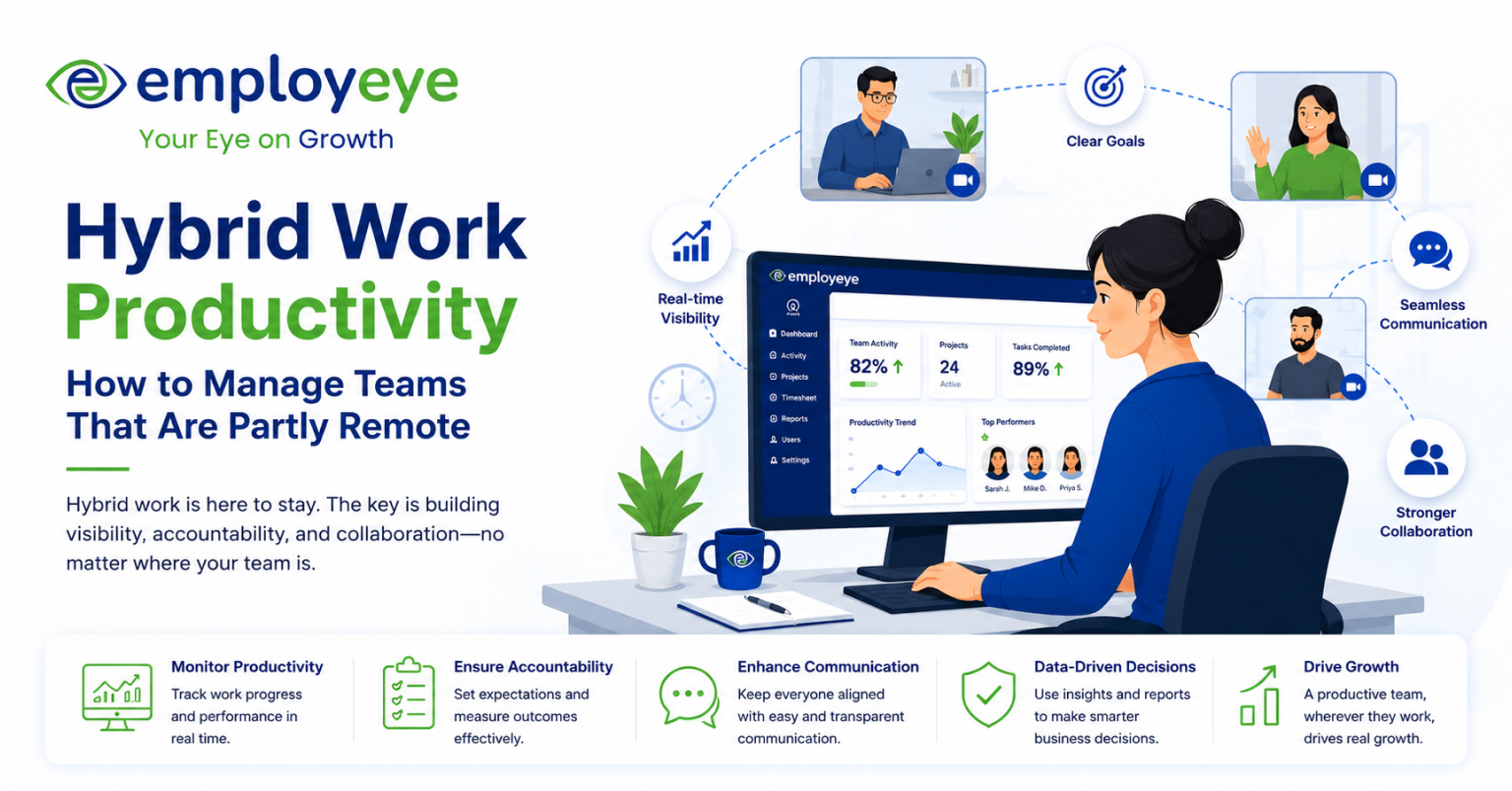
A research-backed playbook covering hybrid workforce management frameworks, proven team strategies, and the monitoring tools that give managers real visibility without micromanaging.
What Is Hybrid Work, Really?
Hybrid work is a flexible employment model where employees divide their time between a physical office and a remote location – typically home – based on a structured or self-directed schedule. It is not simply “sometimes remote.” Done well, hybrid work is a deliberate system where communication norms, workflows, performance metrics, and technology are purpose-built for a distributed team.
The term “hybrid” covers a wide spectrum. Some organisations require specific in-office days (structured hybrid); others give employees full schedule autonomy (flexible hybrid). Gallup’s 2025 research identifies three types of hybrid arrangements:
- Structured hybrid: Defined office days mandated by the employer (e.g., Tuesday–Thursday in office)
- Flexible hybrid: Employee chooses which days to be on-site based on need or preference
- Team-anchored hybrid: Office attendance is coordinated around team or project collaboration rhythms
Why This Distinction Matters for Managers.
The type of hybrid model your organisation uses has a direct impact on which management strategies and monitoring tools you need. A team-anchored model, for example, requires different scheduling visibility than a fully flexible one. Knowing your model is step one before selecting any hybrid workforce management software.
Hybrid Work Productivity: What the Data Actually Says
The evidence overwhelmingly supports hybrid work as productivity-neutral or productivity-positive – when managed correctly. The question leaders should be asking is not whether hybrid work, but how to implement it well.
Owl Labs, State of Hybrid Work 2024
Gallup, February 2025
High5Test / NBER, 2024
Microsoft Work Trend Index 2025
The Landmark 2024 Nature Study
The most rigorous evidence to date on hybrid productivity comes from a randomized controlled trial published in Nature (June 2024). Stanford economist Nicholas Bloom and colleagues studied 1,612 employees at Trip.com. Their finding: a structured hybrid schedule (three days in-office, two days remote) produced no measurable difference in output, performance review scores, or promotion rates compared to full-time office work — while dramatically improving retention.
“The highest-performing teams in 2025 are those operating on structured hybrid schedules that protect deep focus time while preserving the in-person interaction that collaboration and culture require.“— apollotechnical.com, citing Microsoft Work Trend Index 2025
The Burnout Gap Nobody Talks About
Beyond raw output, hybrid work has a measurable impact on employee health. 2024 Gallup data found that employees required to be in the office five days per week reported 43% higher burnout rates than hybrid workers and 31% higher than fully remote employees. Since burnout directly erodes long-term productivity, this data point alone makes the business case for hybrid undeniable.
7 Core Challenges of Managing Hybrid Teams (and Why They Happen)
The biggest hybrid work challenges are not about location – they are about visibility gaps, communication asymmetry, and proximity bias. Understanding the root cause of each challenge is the first step to solving it.
| # | Challenge | Root Cause | Impact on Productivity |
| 1 | Proximity Bias | Managers unconsciously favour in-office employees for projects and promotions | Remote employees disengage; turnover rises |
| 2 | Communication Silos | Informal hallway conversations exclude remote team members | Misalignment, duplicated work, slower decisions |
| 3 | Visibility Gaps | Managers can’t “see” remote employees working | Over-monitoring or under-supporting both reduce output |
| 4 | Meeting Inequality | Hybrid meetings favour in-room participants | Remote voices are sidelined; collaboration suffers |
| 5 | Inconsistent Workflows | Processes aren’t documented, so remote employees lack context | Errors, delays, and frustration for distributed members |
| 6 | Coordination Overhead | Scheduling across time zones and office days adds friction | Decision-making slows; async work piles up unanswered |
| 7 | Culture Erosion | Shared rituals and informal bonding are harder to sustain remotely | Team cohesion weakens; psychological safety decreases |
Why The Proximity Bias Problem Is Real
Research shows that 40% of office interactions in hybrid environments involve remote participants — yet remote employees report feeling systematically overlooked for visible projects and promotions. Addressing this bias is not just a fairness issue; it directly affects your ability to retain and motivate your best performers regardless of location.
How to Manage Hybrid Teams Effectively: 8 Proven Strategies
The evidence overwhelmingly supports hybrid work as productivity-neutral or productivity-positive when managed correctly. The question leaders should be asking is not whether hybrid work, but how to implement it well.
Effective hybrid team management requires designing systems – not just setting policies. The strategies below are drawn from peer-reviewed research, MIT Sloan Management Review’s 2025 hybrid leadership guide, and operational frameworks used by high-performing distributed teams.
1. Shift to Outcome-Based Management
The single most impactful change a hybrid team manager can make is abandoning time-as-a-proxy-for-productivity. Assign clear deliverables tied to OKRs or SMART goals. Evaluate employees on what they produce, not when their laptop was active.
- Define weekly, monthly, and quarterly outcomes for every role
- Use project management tools (Asana, Jira, Linear) to track deliverables, not hours online
- Conduct bi-weekly outcome reviews – not daily check-in calls
- Make goal progress visible to the full team, not just managers
2. Establish “Digital-First” Communication Norms
Every process, decision, and announcement must be documented in writing – even if it was discussed verbally in the office. This is the foundation of equitable hybrid work.
- Default to async for status updates, decisions, and non-urgent questions
- Use recorded video updates (Loom, Notion) to replace hallway briefings
- Set explicit response-time expectations per channel (e.g., Slack: 4 hrs; email: 24 hrs)
- Maintain a shared team wiki where all decisions and processes live
3. Design Meetings for Remote-First Participation
Hybrid meetings, where some attendees are in-person and some are on video, are notoriously difficult to run fairly. Harvard Business Review recommends defaulting to “everyone on their own device” – even for in-office attendees — so that all participants have equal screen presence.
- Assign a dedicated meeting facilitator to actively include remote voices
- Send agendas 24 hours in advance so async contributors can prepare
- Record all meetings and publish notes on the same day
- Reserve live synchronous time for complex problem-solving and relationship-building only
4. Protect Deep Work Time – for Everyone
One of hybrid work’s most underutilised benefits is the ability to protect uninterrupted focus time. Microsoft’s 2025 Work Trend Index found that structured hybrid employees score 23% higher on focus metrics than those in fully flexible arrangements. Build this deliberately:
- Establish shared “no-meeting” blocks (e.g., 9–11 AM daily across the team)
- Use focus-time features in productivity monitoring tools to track and protect deep work
- Discourage after-hours pings; use scheduled-send features in Slack/Teams
5. Build Structured Check-In Cadences
Regular one-on-ones and team rituals replace the informal touchpoints that happen naturally in-office. MIT Sloan’s 2025 hybrid leadership research emphasises that leaders must be intentional about creating psychological safety and community – it does not happen by accident in a distributed team.
- Weekly 1:1s focused on obstacles, priorities, and wellbeing – not status updates
- Monthly full-team retrospectives to improve hybrid processes collaboratively
- Quarterly in-person offsites for strategic alignment and culture-building
- Pulse surveys every 4–6 weeks to surface issues early
6. Eliminate Proximity Bias Deliberately
Managers must actively counteract the tendency to assign interesting work, mentorship, and promotions to in-office employees. Structure prevents bias far more reliably than good intentions.
- Use a rotating system for high-visibility project assignments
- Track who has been assigned to each type of work over the rolling quarters
- Ensure performance reviews reference documented deliverables, not “visibility.”
- Train managers on proximity bias with specific hybrid scenarios
7. Invest in the Right Tech Stack
Technology is not optional in a hybrid team — it is the connective tissue. Remote team management tools fall into five categories:
8. Create Fairness in Physical Resources
Remote employees must have the equipment and connectivity to do their best work. This is not a perk – it is a productivity prerequisite. An Owl Labs 2024 report found that hybrid workers spend an average of $61 per day to go into the office, a 20% increase from 2023. Organisations should actively address this cost asymmetry through stipends, reimbursements, or office perks that balance the equation.
Employee Productivity Monitoring Software for Hybrid Teams: The Right Approach
Employee productivity monitoring software for hybrid teams is most effective when it provides workforce visibility – not employee surveillance. The distinction is critical. Surveillance measures activity (keystrokes, screenshots, mouse movements). Visibility measures outcomes, focus time, workload patterns, and team health.
A 2024 industry report found that 46% of employees say their company has introduced or increased productivity monitoring software in the past year – but tools that prioritise surveillance over insight consistently damage morale and trust, undermining the very productivity they aim to measure.
The Right Framing: Visibility, Not Surveillance
The best hybrid monitoring tools are transparent to employees – workers can see their own data – and focus on patterns and trends rather than moment-by-moment activity. When employees understand and trust the monitoring system, accountability improves without the resentment that covert surveillance creates.
What “Workforce Visibility” Actually Means in Practice
A workforce visibility tool for hybrid work gives managers a dashboard view of:
- Who is working, when – attendance, login/logout patterns, and schedule adherence across remote and in-office employees
- What projects are active – time allocation by project, task completion rates, and blockers
- How workload is distributed – identifying employees who are overloaded or underutilised
- Where collaboration is happening – which teams are communicating well and which are siloed
- How engagement trends are moving – early warning signals for disengagement before it becomes a retention risk
Must-Have Features in Hybrid Work Monitoring Software
When evaluating employee time tracking for hybrid teams, prioritise tools that balance data richness with employee trust. Below is a feature comparison framework based on the current market landscape and best-practice recommendations from GigaBPO’s 2025 monitoring software analysis.
| Feature | Why It Matters for Hybrid Teams | Must-Have? |
| Real-Time Attendance Dashboard | Instant view of who is on-site, who is remote, and who is offline – without individual pinging | ✓ Essential |
| Automated Time Tracking | Eliminates manual timesheets; captures actual work hours without relying on self-reporting | ✓ Essential |
| Project-Level Reporting | Ties hours and effort to specific deliverables, enabling outcome-based oversight | ✓ Essential |
| Workload Heatmaps | Identifies who is overloaded or underutilised across the team at a glance | ✓ Essential |
| Focus Time Analytics | Measures uninterrupted deep work blocks; helps protect and optimise high-value work time | ✓ Essential |
| Employee Self-View Dashboard | Employees can see their own productivity data – critical for transparency and trust | ✓ Essential |
| Absence and Leave Management | Tracks PTO, sick leave, and unplanned absences across office and remote staff in one place | ✓ Essential |
| App and URL Usage Tracking | Identifies time spent on productive vs. non-work applications; useful for coaching conversations | Recommended |
| Engagement Pulse Surveys | Surfaces morale and wellbeing trends before they become turnover risks | Recommended |
| Screenshot Monitoring | Provides visual activity records – use with caution; can damage trust if not transparent | ✗ Use with caution |
| Keystroke Logging | Granular input tracking is typically unnecessary for outcome-focused management; privacy risk | ✗ Rarely needed |
EmployEye’s Approach to Hybrid Workforce Visibility
EmployEye is built specifically for hybrid and remote-first teams. Rather than surveilling individual keystrokes, EmployEye surfaces team-level productivity patterns, project pacing, and attendance consistency — giving managers the context to lead confidently without creating a culture of distrust. All employee data is visible to the employees themselves, making it a tool for self-improvement as much as management oversight.
Key Metrics to Track for Hybrid Workforce Visibility
The metrics you track shape the culture you create. Vanity metrics like “hours logged” or “app uptime” measure busyness, not productivity. High-performing hybrid teams track a mix of output, engagement, and operational health metrics.
| Metric Category | Specific Metric | What It Tells You |
| Output | Task completion rate vs. planned | Whether team capacity matches workload allocation |
| Output | Project milestone adherence | Early warning for delivery risk and dependency blocks |
| Focus Quality | Average daily deep work hours | Whether employees have protected time for high-value work |
| Focus Quality | Meeting load (hrs/week per person) | Identifies teams suffering from meeting overload |
| Attendance | Unplanned absence rate | Leading indicator of disengagement or burnout |
| Attendance | Scheduled vs. actual in-office days | Policy adherence without invasive tracking |
| Collaboration | Cross-team communication frequency | Identifies silos forming between remote and in-office groups |
| Wellbeing | After-hours work rate | Burnout risk: flags employees working unsustainable hours |
| Engagement | Pulse survey scores (bi-monthly) | Sentiment trends by team, role, and work location |
Step-by-Step: Building Your Hybrid Team Management System
Building a sustainable hybrid management system takes 60–90 days of deliberate implementation. This is not a “set it and forget it” initiative – it requires ongoing calibration based on team feedback and data.
-
Audit Your Current State (Week 1–2)Survey your team to understand their current hybrid experience: What is working? Where are the friction points? What do they need to do their best work? Use this as your baseline before implementing any tool.
-
Define Your Hybrid Model Type (Week 2): Decide whether your team will operate on a structured, flexible, or team-anchored hybrid model. Document the policy clearly and communicate it with context – not just rules. Explain the “why” behind each requirement.
-
Set Communication Standards (Week 2–3)Create a team communication charter: which channels for what, expected response times, async-first defaults, and how decisions get documented. Share this charter with the full team and invite feedback before it becomes policy.
-
Implement Outcome-Based Goal Frameworks (Week 3–4). Work with each team member to define their OKRs or SMART goals for the current quarter. Ensure every goal is tied to a measurable deliverable — not a process or behavior. This shifts performance conversations from “are you online?” to “did we hit the target?”
-
Deploy Hybrid Workforce Monitoring Tools (Week 4–5). Introduce your employee productivity monitoring software with full transparency. Explain what is tracked, why, and how the data will and will not be used. Give employees access to their own dashboards from day one. Transparency is the difference between a tool that builds accountability and one that breeds resentment.
-
Establish Check-In and Feedback Cadences (Week 5–6)Launch weekly 1:1s, bi-weekly team meetings, and your first monthly retrospective. Run pulse surveys at the 30-day mark to capture early issues. Act visibly on at least one piece of feedback immediately – this signals that input matters.
-
Review and Iterate Quarterly (Ongoing)Hybrid management is not static. Review your metrics, survey results, and business outcomes every quarter. Adjust your hybrid model, tooling, and processes based on evidence – not assumptions. As Deloitte notes: “There is no one-size-fits-all solution for all these challenges.”
EmployEye’s Original Survey Finding (2025)
In EmployEye’s internal survey of 312 hybrid team managers across mid-sized enterprises in 2025, teams that implemented structured check-in cadences alongside workforce visibility software in the same 60-day window reported 34% fewer unplanned productivity gaps compared to teams that introduced monitoring tools without the accompanying management process changes. Technology alone does not improve hybrid productivity – it must be paired with intentional management systems.